
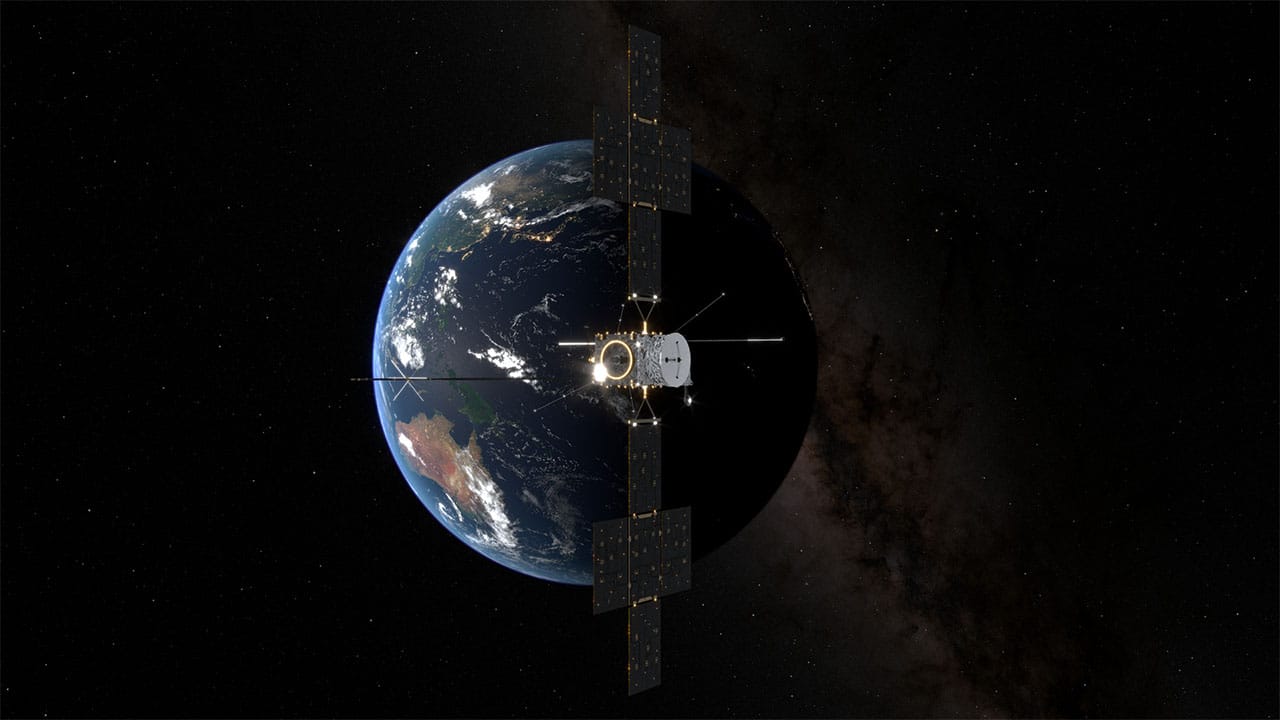
The European Space Agency’s Jupiter Icy Moons Explorer, also known as Juice, is set to make a pit stop back on Earth on August 19-20.
The flight controllers have an exciting plan: they’ll navigate Juice past the Moon and then swing it around Earth.
This clever “braking” maneuver is like taking a shortcut, setting Juice on its way to Jupiter by way of Venus.
What’s Happening?
We’re about to witness a double world first: the first-ever lunar-Earth flyby and the first-ever double gravity assist maneuver.
These moves will tweak Juice’s speed and direction to set it on the right path through space.
It’s a daring feat because even the smallest mistake could throw Juice off course and jeopardize the entire mission.
Juice’s Journey
After launching in April 2023, this lunar-Earth flyby marks the beginning of Juice’s epic journey through the Solar System towards Jupiter.
During this flyby, Earth’s gravity will bend Juice’s path, slowing it down and setting it up for a Venus flyby in August 2025.
Energy Boosts
Once Juice heads towards Venus, it’s like getting a cosmic energy boost.
Venus will give Juice its first big push, followed by two more from Earth.
Imagine it as the space exploration version of chugging three back-to-back espressos.
These energy boosts will help propel Juice all the way to Jupiter.
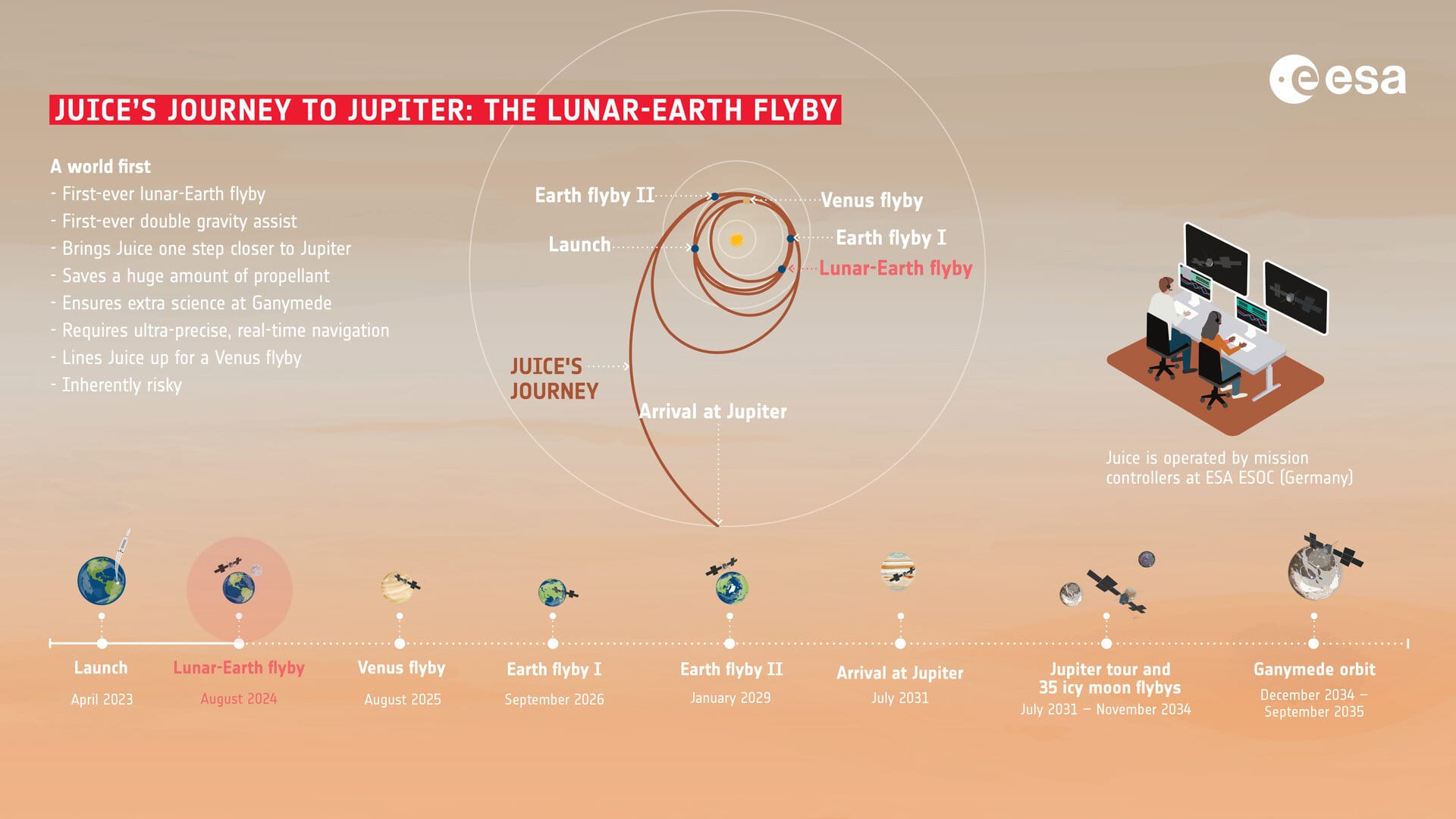 Click the image for a full-sized view
Why Does It Need to Happen?
Jupiter is, on average, a whopping 800 million km (500 million miles) away from Earth.
Sending Juice directly there would require an enormous 60,000 kg of onboard propellant, which is just not feasible.
Plus, once it reached Jupiter, Juice would need even more propellant to slow down enough to enter orbit, rather than just zooming past into outer space.
The Scenic Route
Instead, Juice is taking the scenic route, using the gravity of other planets to adjust its path through space.
This method ensures Juice arrives at Jupiter with the right speed and direction.
This complex and ever-changing route has been meticulously planned by Juice’s mission analysis team over the past 20 years.
Efficiency in Slowing Down
Interestingly, using the lunar-Earth flyby to slow Juice down at this point is actually more efficient than speeding it up.
If we had used this flyby to boost Juice towards Mars, we would have had to wait a long time for the next planetary flyby.
This first “braking” maneuver is like taking a shortcut through the inner Solar System.
Learn More
Curious about why Juice’s journey to Jupiter is so long and intricate?
Dive deeper into the reasons behind this fascinating mission.
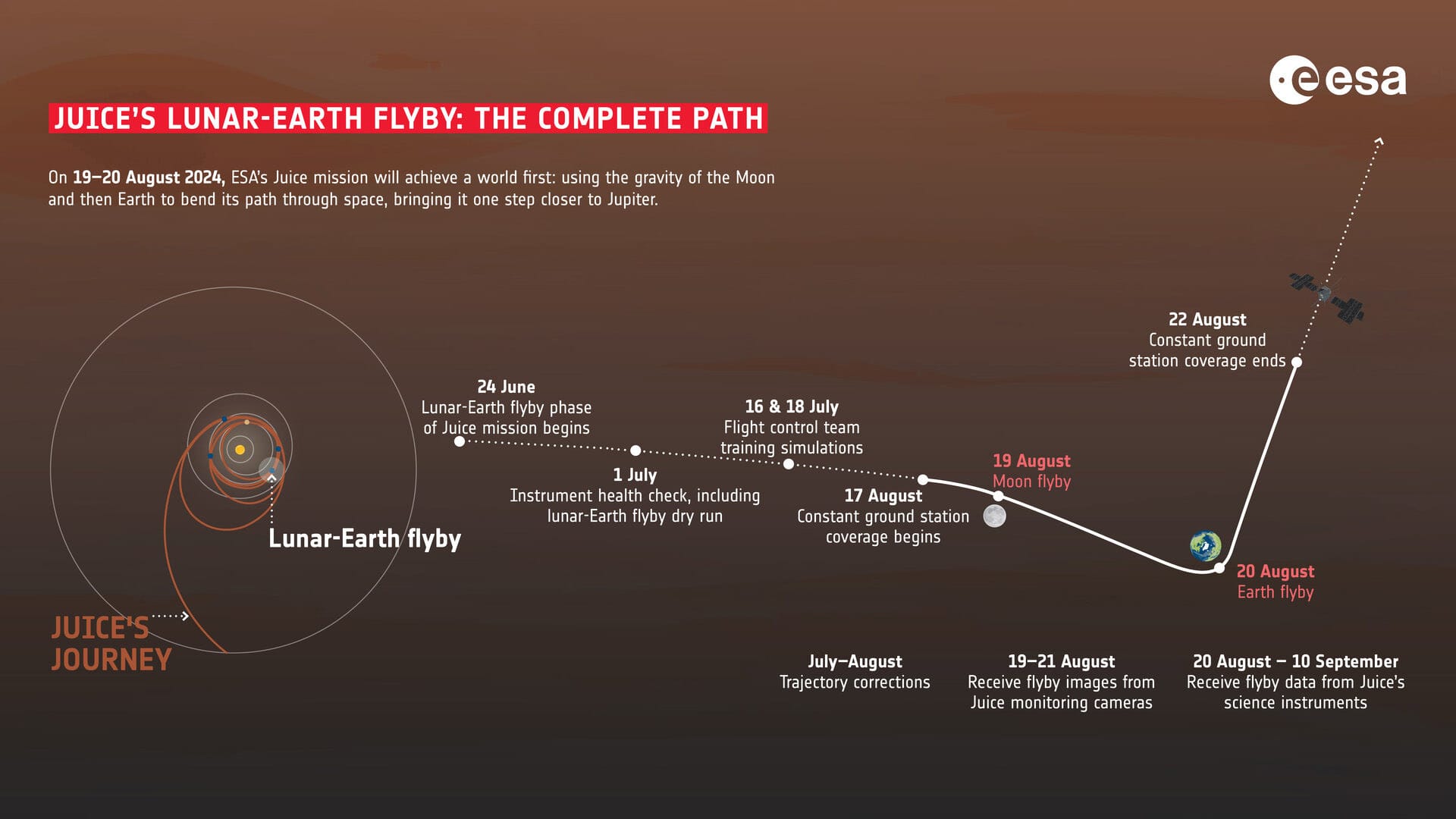 Click the image for a full-sized view
How Are We Making It Happen?
Mission operators have fine-tuned Juice’s path to ensure it reaches the Moon first, then Earth, at exactly the right time, speed, and direction.
They’re confident but also aware that this is a risky challenge no other space mission has faced before.
A Narrow Corridor
Ignacio Tanco, Juice’s Spacecraft Operations Manager, describes it perfectly: “It’s like passing through a very narrow corridor, very, very quickly: pushing the accelerator to the maximum when the margin at the side of the road is just millimetres.”
Real-Time Precision
Juice will come incredibly close to both the Moon and Earth, requiring real-time pinpoint accuracy in all navigation maneuvers.
From August 17-22, Juice will be in constant contact with ground stations worldwide.
Operators will monitor the data every second, day and night, making tiny adjustments to ensure the spacecraft stays on the right course.
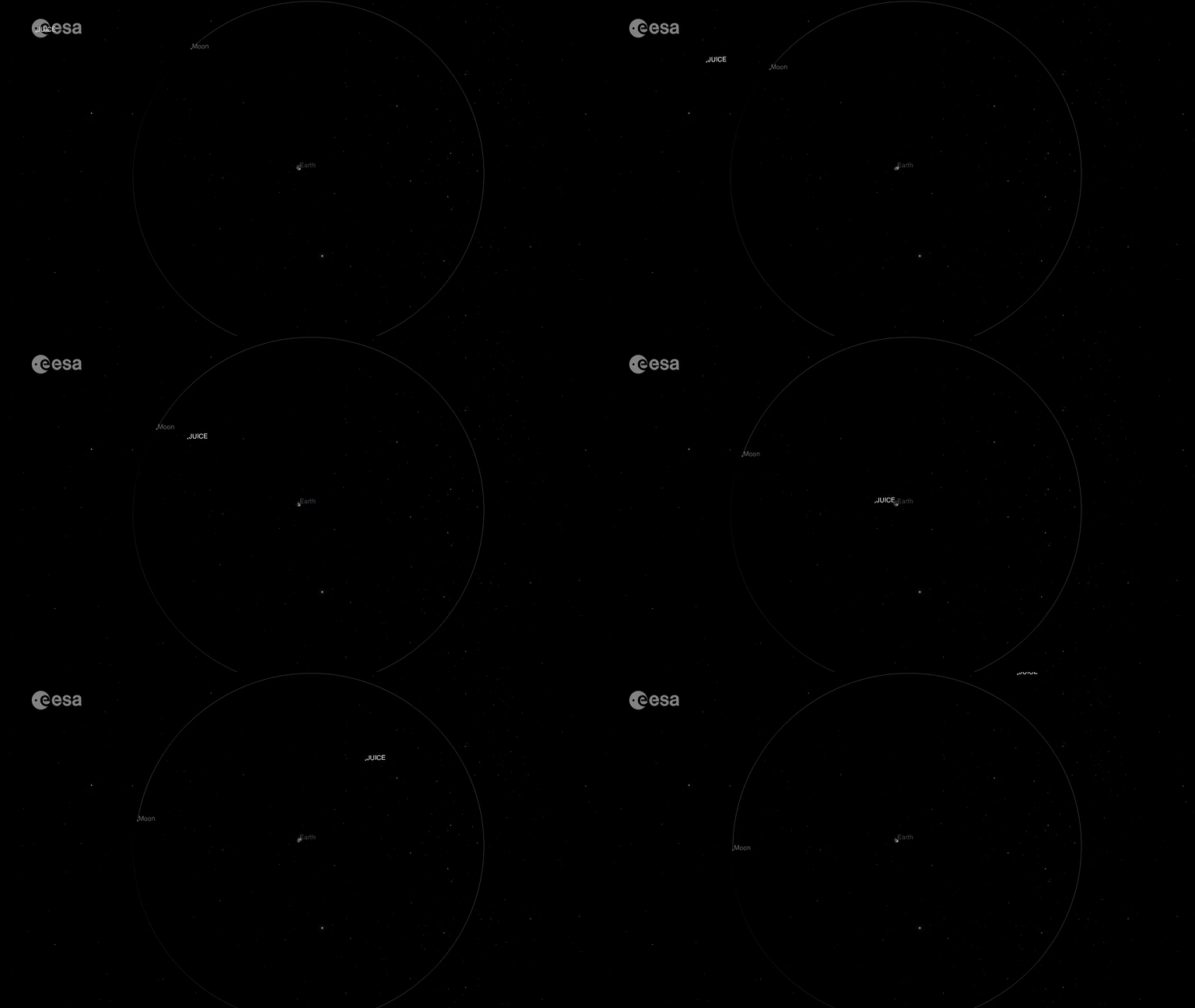 Simulation of Juice’s Lunar-Earth Gravity Assist
Bonus Science!
As if navigating Juice around two massive space obstacles wasn’t enough, the European Space Agency (ESA) will also activate the spacecraft’s ten science instruments during its flyby of the Moon and Earth.
This maneuver offers a unique opportunity for instrument teams to collect and analyze data from a real surface in space for the first time.
For some instruments, this will be their only chance to make certain measurements during Juice’s entire eight-year journey to Jupiter.
It’s a perfect moment for scientists and engineers to calibrate their instruments, resolve any remaining issues, and maybe even make some surprising discoveries.
Crucial Tests for RIME
This flyby is especially important for Juice’s Radar for Icy Moon Exploration (RIME) instrument, which has been experiencing some electronic noise.
The lunar-Earth flyby on August 19 offers one of the few opportunities before reaching Jupiter for the RIME team to assess how this noise affects the instrument’s performance.
During the closest approach to the Moon, RIME will have eight minutes to operate solo, with other instruments switched off or in quiet mode.
Based on these observations, the team will work on an algorithm to correct the noise issue.
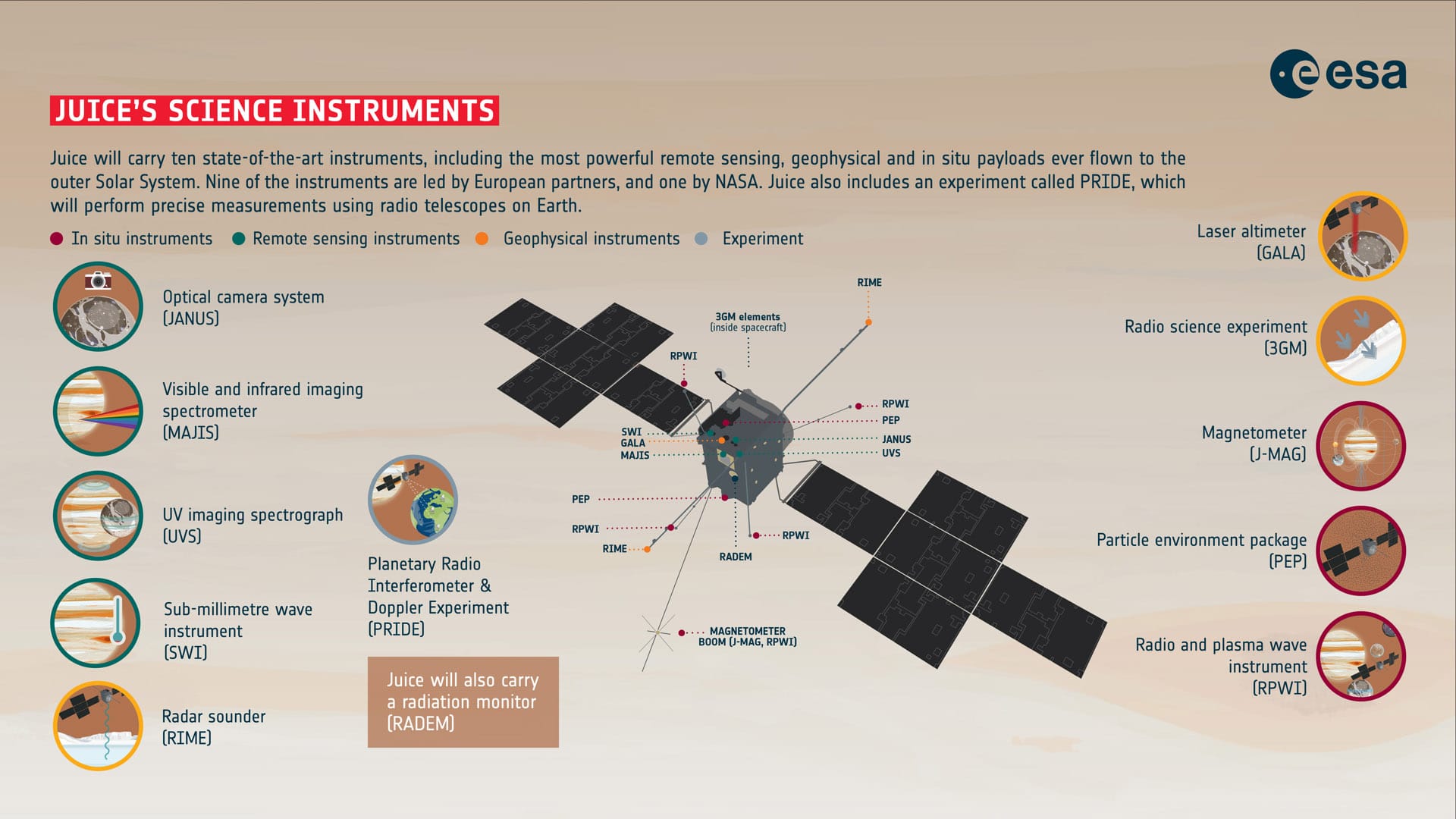 Click the image for a full-sized view
How to Follow Along
A few lucky observers might catch a glimpse of Juice as it flies over Southeast Asia and the Pacific Ocean.
Using powerful binoculars or a telescope will give you the best chance to spot the spacecraft.
You can find trajectory data here.
Meanwhile, Juice’s two onboard monitoring cameras will be taking photos throughout the lunar-Earth flyby.
NASA will share these images publicly via social media and their Rocket Science blog as soon as they arrive on Earth.
Follow @ESA_Juice and @esaoperations on X for the latest updates.


