
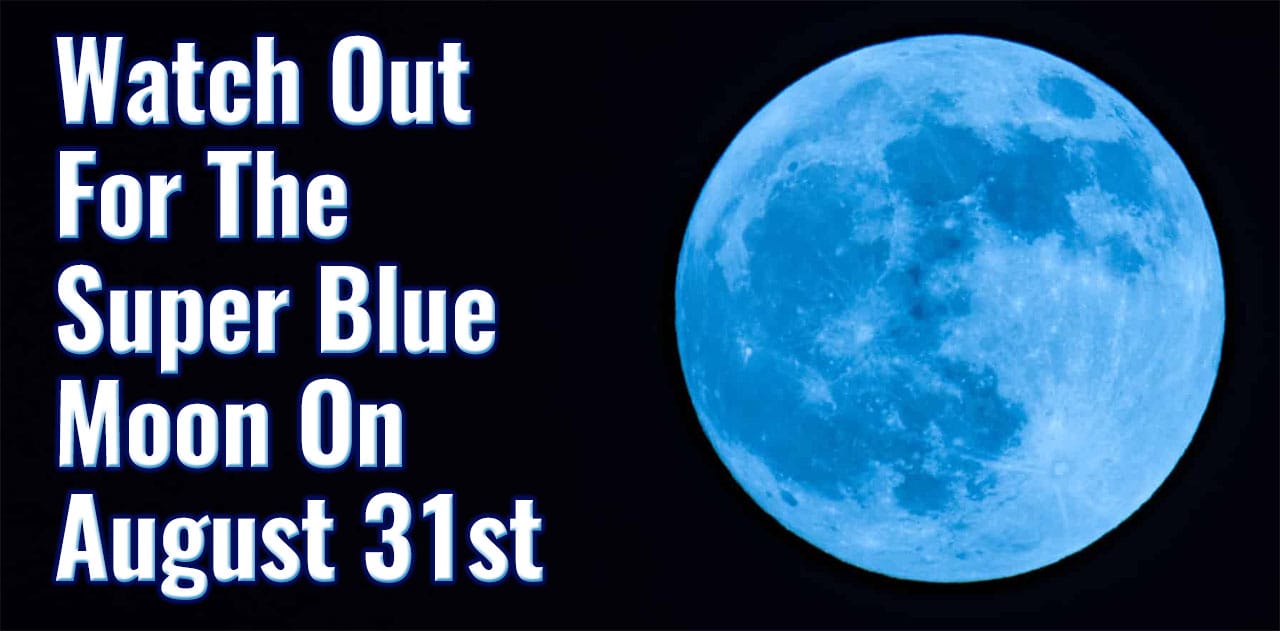
August is one of those rare months when there is a Blue Moon.
The common understanding of a “Blue Moon” is that is is the second Full Moon in the same calendar month.
And in August (2023), there are Full Moons on August 1st and August 30th/31st (depending on where you live).
In the USA, the Blue Moon is on August 30th while in Europe & Africa, it’s on August 31st.
That’s because of the timezone differences between these areas of the world.
But what was also special about the two Full Moons in August is that both were Supermoons with the Moon being slightly closer to Earth during the second Full Moon.
 Times and dates of Supermoons as calculated for the USA by my LunarPhase Pro software
What Is A Blue Moon?
A blue moon is a relatively rare occurrence.
A full moon occurs every 29.5 days on average.
When a calendar month of 30 or 31 days has two Full Moons, the second Full Moon is known as a Blue Moon.
Blue moons usually occur once every two and a half years.
Since February only has 28 days (or 29 in a Leap Year), it can never have a Blue Moon as the month is just too short.
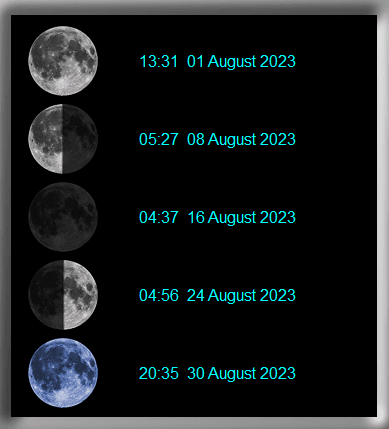 Moon Phases for August 2023 (LunarPhase Pro)
The term “Blue Moon” is believed to have originated in 1883 after the eruption of Krakatoa.
The volcano put so much dust into the atmosphere that the Moon actually looked blue in color.
This was so unusual that the term “once in a Blue Moon” was coined.
However, Blue Moon was also used in much the same way we use the term “Harvest Moon”.
There were twelve names for full moons, one for each month, and the name Blue Moon was also used in years which had 13 full moons.
It referred to the third full moon of the four occurring between an equinox and solstice in that year.
A misinterpretation of this led to a Sky and Telescope Magazine “Star Quiz” in July 1943 followed by an article in March 1946 which stated that the second full moon in any calendar month was called a Blue Moon (attributed to the 1937 Maine Farmers’ Almanac), and this definition has now become its accepted meaning.
What Is A SuperMoon?
When a Full Moon occurs at its closest point to Earth during its orbit, the Moon appears larger and brighter in the sky, becoming what is commonly known as a Supermoon.
On August 1st, the Moon was 222,126 miles (357,477 km) way from Earth (the average is 238,855 miles / 384,400 km) and on August 30th/31st, the Moon will be 222,075 miles (357,395 km) away from Earth.
So there’s only a few tens of miles and kilometers between the two Supermoon distances.
The point of closest approach of the Moon to the Earth is called the Moon’s Perigee.
Since the Moon’s orbit is an ellipse rather than a circle, the Moon’s Perigee constantly changes.
It can happen when the Moon is at any phase (Full, New, First Quarter, Last Quarter or anywhere in between).
But a Supermoon only happens when the Moon is both at Full phase and at Perigee.
And it’s how the Sun casts light on the Moon that dictates what Moon phase we see when we see look up from Earth.
A Supermoon appears to be around 14% bigger and 30% brighter in the sky than a Full Moon that’s at it’s farthest from Earth (known as its Apogee).
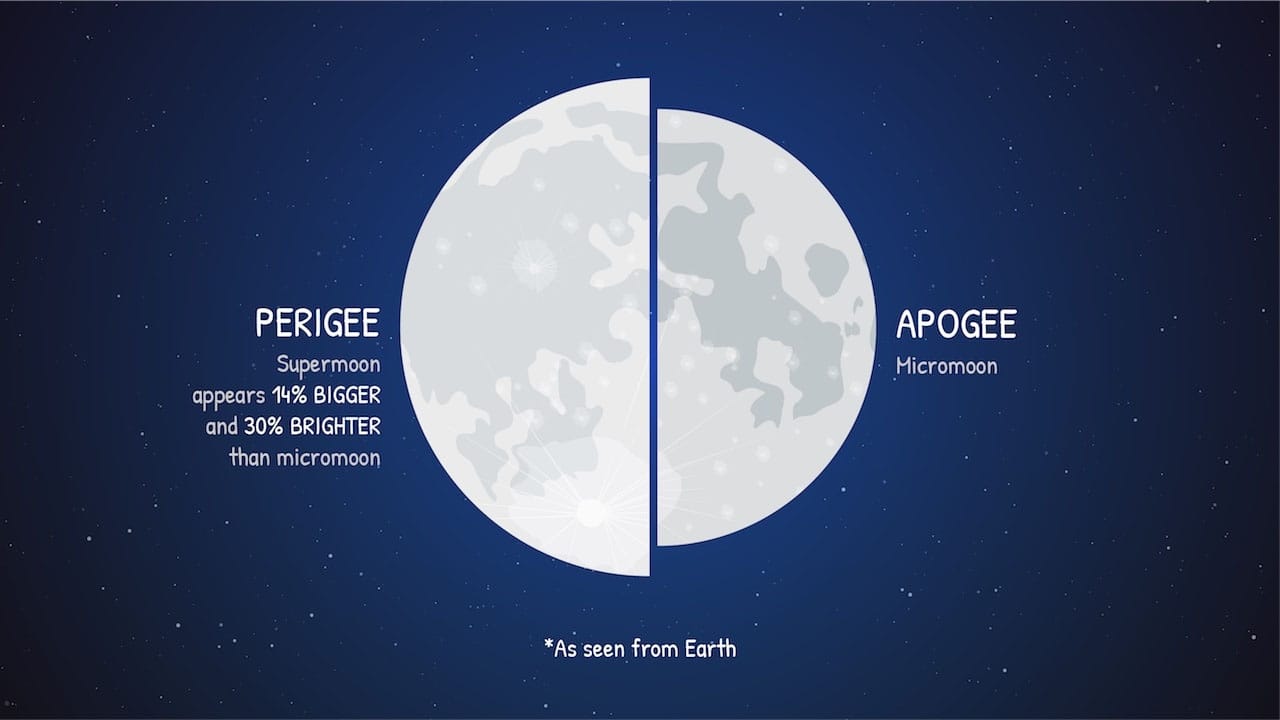
There’s no specific term do describe a Full Moon that’s at it’s maximum distance from Earth (an anti-Supermoon maybe – just throwing that out there!) but the term MicroMoon has been used by some people.
The Moon has to be more than 251,655 miles (405,00 km) away from the center of the Earth for this to happen.
Bear in mind that a Supermoon is not 14% bigger in the sky than a regular Full Moon, it’s 14% bigger than a Micromoon, and it’s slightly larger size that a regular Full Moon probably won’t be noticeable.
What will be noticeable is that the Moon will look significantly larger when it’s near the horizon rather than when it is high in the sky.
This is known as the Moon Illusion and there’s a good NASA article about it here.
The Super Blue Moon
Supermoons aren’t that rare.
Of the possible 12 or 13 Full Moons each year, usually three or four will be classified as Supermoons.
But the confluence of a Blue Moon and a Supermoon is very rare given the individual events and circumstances that lead to each separately.
I don’t know if the correct term to describe this event is Blue Super Moon or Super Blue Moon.
The August 30th/31st Supermoon won’t be colored blue (unless there’s a major volcanic eruption somewhere in the world, perhaps).
But it is a pretty unique event in the astronomical calendar.
Check it out if you get the chance.
The actual instant when it occurs will be between 5pm and 8pm in the USA (30th) and between 1am and 4am in Europe and Africa (31st). LunarPhase Pro can calculate the timings of Supermoons and many other lunar phenomena for where you live if you want accurate info.


