
Transportation Secretary Sean Duffy has wasted no time making waves as acting head of NASA.
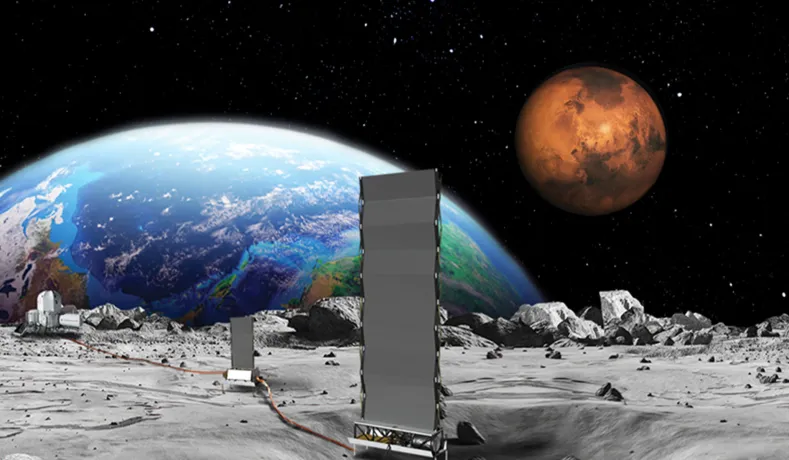
His first big move: fast-tracking the agency’s plan to put a 100-kilowatt nuclear reactor on the Moon by 2030 — a full speed-up from the original timeline.
Alongside that, he’s also doubling down on NASA’s partnerships with private space companies.
“We’re in a race to the moon, in a race with China to the moon, and to have a base on the moon, we need energy,” Duffy told reporters.
“This fission technology is critically important, and so we’ve spent hundreds of million dollars studying, ‘Can we do it?’ We are now going to move beyond studying.”
“Let’s start to deploy our technology to move to actually make this a reality,” he added.
This focus on nuclear power isn’t coming out of nowhere.
It’s been a top Trump administration priority for years, tied to both national security and space exploration goals.
Back in his first term, Trump created the Space Force and put nuclear propulsion and power high on the agenda.
Now, with a second-term team at NASA, the hope is clear: nuclear energy could be the key to long-term human presence not just on the Moon, but eventually on Mars.
Why nuclear?
Because the Moon is unforgiving.
Rovers, habitats, robotics, and life-support systems all need steady, reliable power—and solar isn’t always enough.
Those two-week-long lunar nights are brutal, and heavy batteries aren’t a great solution.
A compact fission reactor could keep things running in the cold and dark, much like nuclear power already does on U.S. submarines and aircraft carriers.
“We could accept the notion that that you don’t put anything in advance of arrival. You just go and make do with what you brought until you can bring more and build more. But why would we do that if we have the plan to get back to the moon?” explained one senior NASA official.
“It’s the difference between getting a new set of keys at the apartment building versus going into the wilderness with an ax.”
Another official put it bluntly: “What it will power is everything we want to do on the moon. What Secretary Duffy has made very clear is: he wants to differentiate Artemis from Apollo. Up to this point, we focused most of our attention on transportation, getting there, which we’ve already done for Apollo. What we want to change, and what we’ll focus on, is staying there. And what you need to stay anywhere is power.”
Of course, this isn’t just about science – it’s about geopolitics.
Duffy’s July 31 directive specifically flagged Chinese and Russian plans to put a reactor on the Moon by the mid-2030s.
Whoever gets there first could, in theory, carve out a “keep-out zone” that would make it harder for the U.S. to establish its Artemis program.
For NASA, that’s not an option.
But Duffy isn’t stopping with the Moon.
He also signed a directive to ramp up NASA’s partnerships with commercial space stations.
Why?
Because the International Space Station is scheduled to retire in 2030, and NASA doesn’t want a gap.
Officials debated three options:
(1) spend billions trying to keep the ISS alive,
(2) build a new government-run replacement, or
(3) team up with industry.
They went with option three — faster, cheaper, and more flexible.
“That’s what commercial low Earth orbit is about,” one NASA official explained.
“How do we get these commercial interests synced up, and how do we get a few players incentivized to solve the problem and ultimately have initially one or two viable commercial platforms ready by the time the ISS is decommissioned?”
This approach also comes with political contrast.
Trump officials argue the Biden administration leaned too heavily on regulation, slowing progress and frustrating private space companies.
Now, with Trump back in office, there’s a clear shift: cut red tape, move hardware, and let industry innovate.
On Tuesday (August 12th, 2025), Trump himself signed an executive order pushing agencies to speed up permits, reviews, and other bottlenecks standing in the way of spacecraft development.
“We’re saying, ‘Get in space now.’ We’re not saying, ‘Do more studies. Do more work,’” a senior NASA said.
“We’re saying, ‘Build the hardware. Go show you can do it.’ And that will be the way we can prevent a gap. Studies will not get us there.”
Critics, especially Democrats, warn that this sharper focus on exploration is sidelining research and pushing talented scientists out of NASA.
But officials push back, insisting this isn’t about giving companies free rein with taxpayer money.
Instead, they see it as the continuation of the public-private model that worked so well with SpaceX.
“SpaceX going to the space station, was a huge public-private partnership success. All these are meant to build on that, to do more of that. Doesn’t mean SpaceX replaces NASA, and a lot of people like to say that. No, it’s a partnership. We work together. We achieve our objectives together.”
Top image: A concept image of NASA’s Fission Surface Power project.(Courtesy of NASA)


