

NASA have said that the technical problems that afflicted the first and second launch attempts of the Artemis I mission have now been fixed.
The third launch attempt date for what has been called “NASA’s Mega Moon Rocket” has been set for September 27th.
The Artemis I rocket is composed of two components – the 30 storey high Space Launch System (SLS) topped by the six-person Orion capsule.
No astronauts will fly on this initial mission; its objective is to test out all components and the heat shield being used on the Orion capsule during its re-entry into Earth’s atmosphere, before any astronauts are put at risk personally.
The mission was first scheduled to launch on August 29th but had to be aborted because engineers were unable to cool one of the rocket’s four core stage RS-25 engines down to a safe temperature in time for liftoff.
NASA announced that it had fixed the problem, which it blamed on a faulty temperature sensor.
Then, during the rocket’s second attempt on September 3rd, an alarm sounded as the craft was being loaded with its supercooled liquid hydrogen fuel, alerting engineers to a gap in the seal of one of the rocket’s engines.
Engineers tried to plug the leak three times but ultimately failed.
NASA said that the leak was at a “quick disconnect” where the SLS core stage met the fuel line from the rocket’s mobile launch tower, which the agency fixed by replacing two seals at the leak point.
While the next launch opportunity will be on September 27th, there is also a backup opportunity on October 2nd.
NASA engineers plan to demonstrate the leak is patched by conducting a test to pump propellant into the craft on September 17th.
“The updated dates represent careful consideration of multiple logistical topics, including the additional value of having more time to prepare for the cryogenic demonstration test, and subsequently more time to prepare for the launch,” NASA officials wrote in a blog post announcing the new launch date.
“The dates also allow managers to ensure teams have enough rest and to replenish supplies of cryogenic propellants.”
If the launch is successful, the plan is to have the Orion capsule do two fly-bys of the Moon 100 kilometers (62 miles) above the lunar surface, flying out as far out as 64,000 km (40,000 miles) beyond the Moon before returning to Earth 38 days after launch.
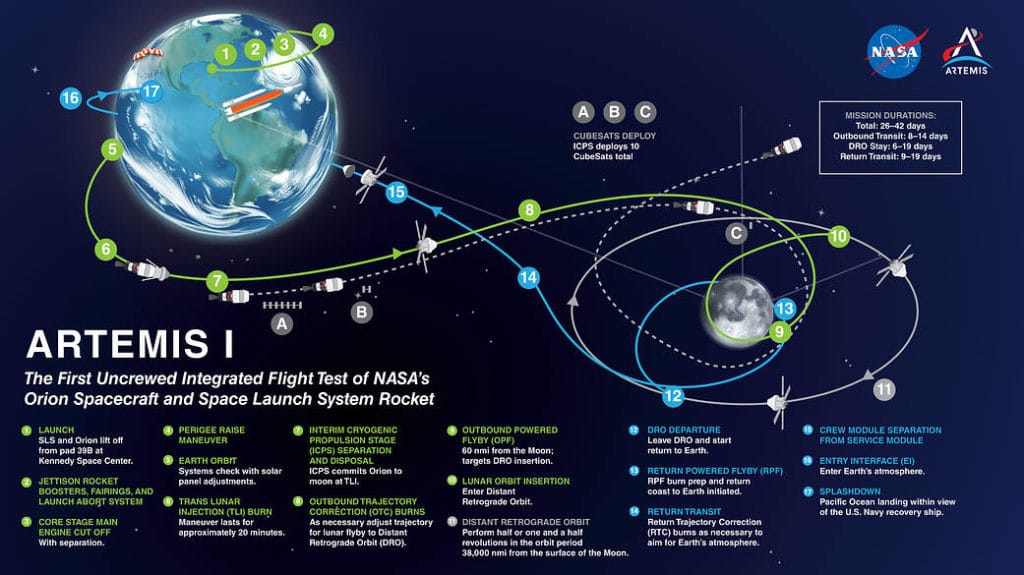
While no astronauts will be flying on the mission, there are three mannequins aboard the capsule that will be used to test radiation and heat levels during the flight.
A Snoopy soft toy is also along for the ride, floating around inside the capsule as a zero-gravity indicator.
When the Orion capsule returns to Earth, it is set to return hotter and faster than any space vehicle has ever previously done, heating up to 2,800 degrees Celsius (5,000 degrees Fahrenheit) as it enters Earth’s atmosphere at 32 times the speed of sound.
This will put the capsule’s ablative heat shield to the test, which, alongside the craft’s parachute, will use air friction to slow Orion down to just 20 mph (32.2 km/h), after which it should plop down safely in the Pacific Ocean off the coast of Baja California, Mexico, ready for retrieval.
NASA has returned to using an ablative heat shield (one that burns off) for Orion rather than using tiles which absorb heat as were used on the .
Those tiles were prone to being damaged and a lost tile led to the demise of the Challenger Shuttle during its re-entry.Space Shuttle
Artemis I will be followed by the Artemis II (in 2024) and Artemis III (in 2025/2026) missions.
Artemis II will make the same journey as Artemis I, but with a four-person human crew, and Artemis III will send the first woman and the first person of color to land on the Moon’s south pole.
Speaking to BBC Radio 4 before the second launch attempt, NASA Administrator Bill Nelson said that the test mission will be a spur for technological innovation and a crucial next step in humanity’s exploration of the cosmos.
“This time we’re going not just to touchdown [on the Moon] and leave after a few hours or a few days — we’re going back to learn, to live, to work, to explore, to determine is there water; therefore on the [moon’s] south pole that would mean we have rocket fuel, we have a gas station up there,” Nelson said. “This time we’re going to learn how to live in that hostile environment for long periods of time, all with the purpose that we’re going to Mars.”


