
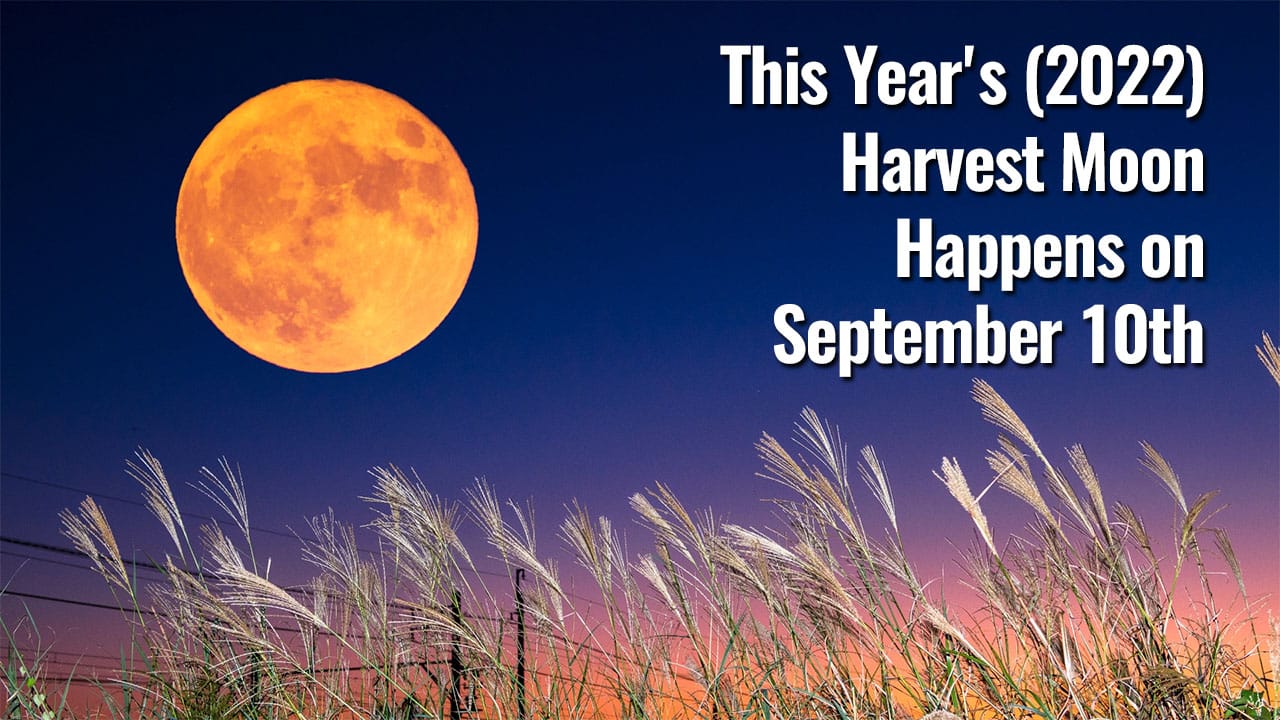
The Harvest Moon is the full moon that’s closest to the Autumnal Equinox (September in the Northern Hemisphere and March in the Southern Hemisphere).
This year’s Harvest Moon reaches its full phase at about 9:58 UT (5:50AM EDT) on Saturday, September 10th.
After Summer gave us three Supermoons in a row and one very nearly Supermoon on May 16th — that is, four full moons that rose during the moon’s closest approach to Earth during its orbit
These lunar close approaches make the moon appear larger in the sky and up to 16% brighter than an average full moon.
The “Sturgeon Moon” on August 12th was the final Supermoon of 2022.
This screenshot from my LunarPhase Pro software shows the New and Full Moons (some of which were Supermoons) up until September this year:
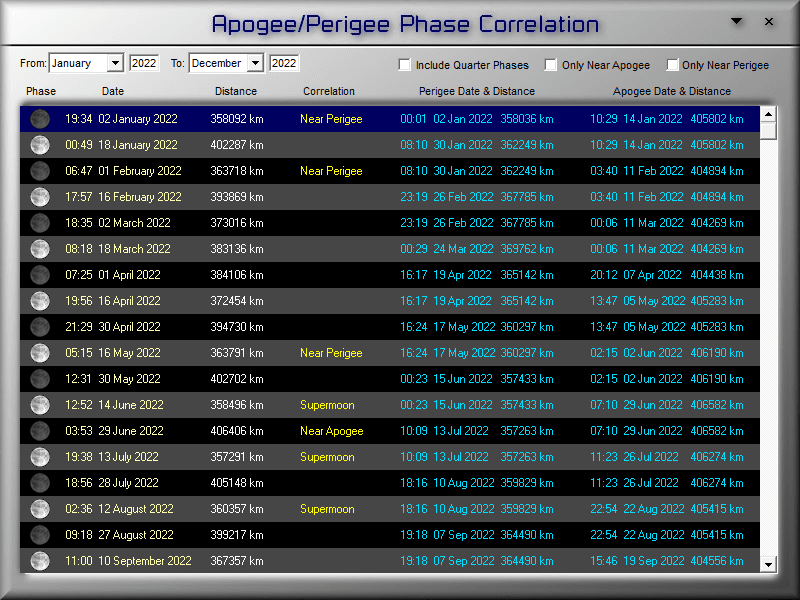
Click the image for a full-sized view
This month’s full moon has been called by its Old European name, the Harvest Moon, since at least 1706.
It’s the full moon closest to the autumnal equinox when many crops are harvested in the Northern Hemisphere, often by the light of this Moon.
The full moon in September is known by other names around the world: Chrysanthemum Moon (China), Singing Moon (Celtic – in this calendar the Harvest Moon occurs in October), Blood Moon (Medieval England), Nut Moon (Cherokee) , Worm Moon (Southern Hemisphere), and other names elsewhere.
Check out the Full Moon Names article to see how full moons are named around the world.
The Harvest Moon frequently coincides with several religious and cultural holidays, including the Mid-Autumn Festival celebrated in China and several other Asian countries, and the 16-day Pitru Paksha period of the Hindu calendar.
Last year, the moon also coincided with the start of the seven-day Sukkot holiday in Judaism.
A full moon occurs about once a month (actually every 29.5 days) when the Sun, Earth and Moon align on an invisible 180-degree line.
The moon’s orbit is inclined to that of Earth’s by about 5 degrees so the Moon is usually a little higher or lower than Earth’s shadow, allowing the sun’s rays to illuminate the side facing Earth.
This is why there isn’t a lunar eclipse every thie there’s a Full Moon but lunar eclipses only happen when there’s a Full Moon.
The next full moon will be at 8:54PM UT (4:54PM EDT) on October 9th. This one is known as Hunter’s Moon.


